

New builds · Guide
How Long Does It Take to Build a House in Auckland?
A phase-by-phase look at the time it takes to build a new home in Auckland, from the first brief to the Code Compliance Certificate, and what sets the pace at each step.
How long it takes to build a house in Auckland depends on a sequence of phases, not one number: months of brief and design, a building consent council must process within 20 working days of a complete application, sometimes a resource consent, then construction, the Code Compliance Certificate and handover. Construction gets the attention, but the phases before it are the ones owners most often underestimate.
We build architectural new homes from an architect's drawings. We will not give you a headline figure that does not fit your project, but we can tell you what sets the length of each phase and where time is usually won or lost.
How long does the design phase take?
Design usually takes months, and it is the phase you have most control over. An architect takes your brief through concept, developed design and detailed drawings, with engineering alongside. Concept settles the shape and layout. Developed design fixes materials, structure and the main services. The detailed drawings are what council reviews and what the builder prices, so a gap in them tends to come back later as a consent query or a variation.
The fastest designs are not the rushed ones. They are the ones where the budget was set early and the builder priced the drawings before they were finished, so nothing has to be redrawn to bring the cost back into line. Our guide to the cost of an architectural home covers how to set that number before the design runs ahead of it.
How long does a building consent take in Auckland?
Under the Building Act 2004, council has 20 working days to process a building consent, counted from the day it receives a complete application. If council asks for further information, the clock stops until you supply it.
Auckland has been running inside that limit. MBIE monitoring for the July to September 2025 quarter put Auckland's median at 15 working days, with 88.4 percent of consents processed within the statutory timeframe, and residential consents at a median of 13 working days. Those are working days, so allow more calendar time. The way to keep it short is a complete application: drawings, specifications and engineering that answer council's questions before it has to ask them.
Will the house need a resource consent too?
Some sites do. If the design sits outside what the Auckland Unitary Plan allows for the address, resource consent is a separate process with its own requirements, and overlays such as Special Character Areas are a common trigger. Check your address on Auckland Council's Unitary Plan viewer and talk to a planner early. If you are still deciding whether to replace the existing house at all, our renovate or rebuild guide covers that call.
What sets the length of construction?
The house itself sets it. Two homes of the same floor area can take very different times to build, depending on:
- Size and storeys: more floor area and more levels mean more structure, more scaffolding and more sequencing.
- Complexity: curved forms, steel, large glazing and bespoke joinery each add steps a simple plan does not have.
- The site: slope, access, retaining and ground conditions shape how quickly the foundations go in.
- Getting weathertight: once the roof, cladding and joinery are on, interior trades can work whatever the weather.
- Finishes: stone, custom cabinetry and specialist tiling run on their own lead times.
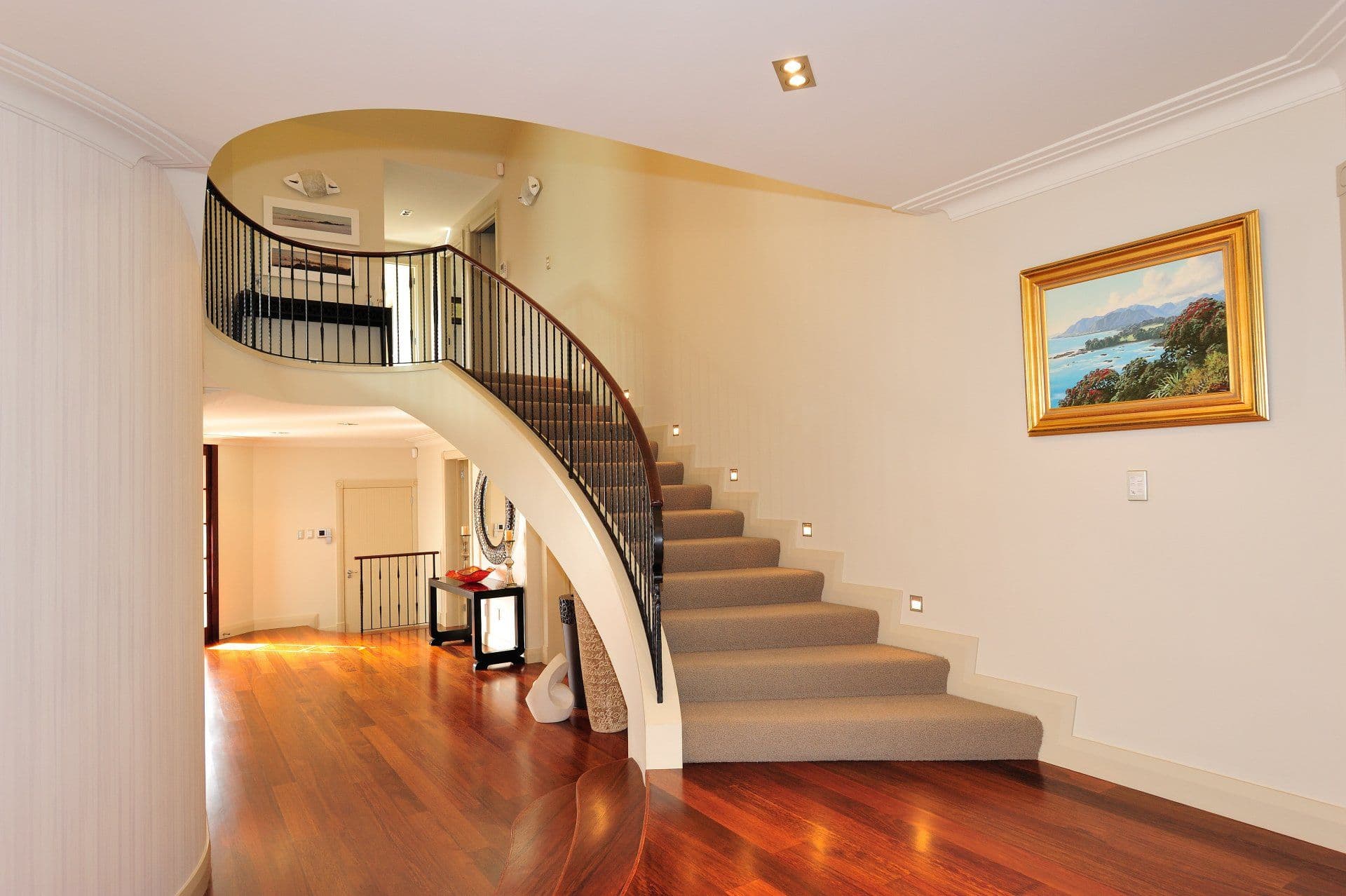
Our Burrell Rd home on Waiheke had several of these at once: three storeys, with a concrete ground floor carrying timber-and-steel upper levels. The One Tree Hill home, with its curved stair, pool and full wine cellar, shows how specialist elements carry their own time.
Weather matters less than people expect. Auckland's mild climate lets construction run year-round, and the real pause is the Christmas and New Year shutdown, when most trades stop for two to three weeks.
What happens between practical completion and moving in?
The last formal step is the Code Compliance Certificate, council's final sign-off that the finished work matches the building consent. Council inspects at stages through the build and again at the end. Trade certificates and inspection records all feed into that sign-off, so a builder who keeps them in order as the job goes avoids a wait at the finish. Handover follows.
How to keep a new build on programme
Builds run to programme when decisions are made early and kept. Settle the specification before construction, lodge a complete consent application, bring your builder in while the drawings can still change, and agree how variations are priced and approved. A change made on site costs time as well as money.
If you are planning a new home in Auckland and want a realistic picture of how long it will take, Talk to Finn. We will look at your drawings or brief, your site and your consent position, and tell you plainly where the time will go.
Common questions
How long does it take to build a house in NZ?
There is no single figure that fits every house. Design usually runs to months and construction depends on size, complexity and site. The one fixed point is consent: council has 20 working days under the Building Act 2004 to process a complete application.
How long does Auckland Council take to issue a building consent?
MBIE monitoring for the July to September 2025 quarter put Auckland's median at 15 working days, with 88.4 percent of building consents processed within the 20 working day statutory timeframe. Residential consents had a median of 13 working days. Requests for further information stop the clock.
Can you build through an Auckland winter?
Yes. Auckland's mild climate means construction runs year-round. The larger seasonal pause is the Christmas and New Year shutdown, when most trades stop for two to three weeks from just before Christmas into January.
What is a Code Compliance Certificate?
It is the council's final sign-off that completed building work matches the building consent, issued after the final inspection. It closes out the consent.
Does a smaller house always build faster?
Not necessarily. Complexity, site and finishes matter as much as floor area. Our Ema Waiheke bach was only 76sqm, but its dark cedar cladding and timber decks into native bush still called for careful, detailed work.
Planning a new home?
Tell us where your design and site are up to. Finn will give you a straight view of the programme from first call to handover.